
How this guide was put together: This guide draws on widely used brewing guidance from tea makers and sellers, plus S.Y.’s own daily brewing. It is a starting point, not a rulebook: taste and adjust. As an Amazon Associate, Lab Brewer earns from qualifying purchases, at no extra cost to you.
Most people getting into Chinese tea ask the same question: should my first brewing vessel be a gaiwan or a small teapot? Both make excellent tea. The difference is how easy they are to use, what they are made of, and which teas they suit best.
What is a gaiwan?
A gaiwan is a lidded bowl on a saucer, usually porcelain or glass. You put the leaves in the bowl, add water, then tilt the lid just enough to hold the leaves back while you pour. It has been used in China for centuries and is still the everyday tool in many tea shops.
Gaiwan vs teapot at a glance
| Gaiwan | Small teapot | |
|---|---|---|
| Learning curve | A few sessions to pour without hot fingers | Easy from day one |
| Works with | Every kind of tea | Best kept to one type (clay) or any tea (glass, porcelain) |
| See the leaves? | Yes, lift the lid | Only in glass pots |
| Cleaning | Rinse and done | Easy for glass and porcelain; unglazed clay needs water only |
| Heat | Loses heat a little faster | Clay and cast iron hold heat longer |
| Typical price | Low | Low (glass) to high (handmade clay) |
Choose a gaiwan if
- You want one vessel for every tea you try, from green to pu-erh.
- You like watching the leaves open and smelling the lid between steeps.
- You want the most neutral taste: glazed porcelain doesn’t absorb flavour.
- You are on a budget. A good starter gaiwan costs little; our researched pick is the Liang baobao white porcelain gaiwan.
Tip for hot fingers: pick a gaiwan with a flared rim, don’t fill it to the brim, and hold it by the rim and the lid knob only.
Choose a teapot if
- You want an easy, drip-free pour without practice.
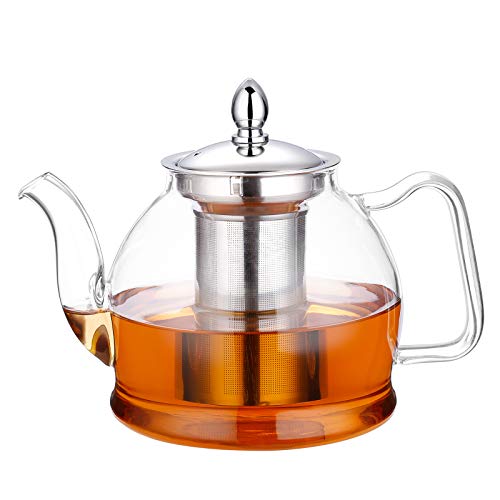
- You brew larger amounts, or mostly Western style. A simple glass pot like the IKEA RIKLIG (S.Y.’s own, hands-on) or the Hiware glass teapot is hard to beat for the price.
- You like the idea of a clay pot that you dedicate to one tea, such as a Yixing pot for dark oolong or pu-erh.
- You want a pot that keeps tea hot for longer, like a cast-iron Iwachu tetsubin-style teapot.
What about Japanese green tea?
For sencha, the traditional tool is a kyusu, a small side-handled teapot with a fine built-in strainer. It handles small, broken Japanese leaves better than either a gaiwan or a standard teapot.
Size matters more than shape
For gongfu brewing, look for 100–150 ml if you drink alone or with one other person, and around 200 ml for a small group. Bigger vessels need much more leaf to taste right.
Picks from this guide
Liang baobao 200 ml gaiwan: a simple white porcelain starter gaiwan.

Hiware 1000 ml glass teapot: an easy budget teapot with a removable infuser.
As an Amazon Associate I earn from qualifying purchases.
The short version
If you are just starting with Chinese tea, get a plain porcelain gaiwan of about 100–150 ml: it is cheap, works with every tea and teaches you how each one changes from steep to steep. Add a teapot later for easy pouring, bigger batches or a clay pot dedicated to your favourite tea.
About the reviewer: S.Y. is the tea drinker behind Lab Brewer, brewing daily for years with an always-hot boiler, a SMEG kettle, a BUYDEEM health kettle and an IKEA RIKLIG teapot, mostly pu-erh, dark oolong and herbal remedies. Hands-on reviews cover gear S.Y. owns; everything else is clearly marked as researched. More about Lab Brewer.